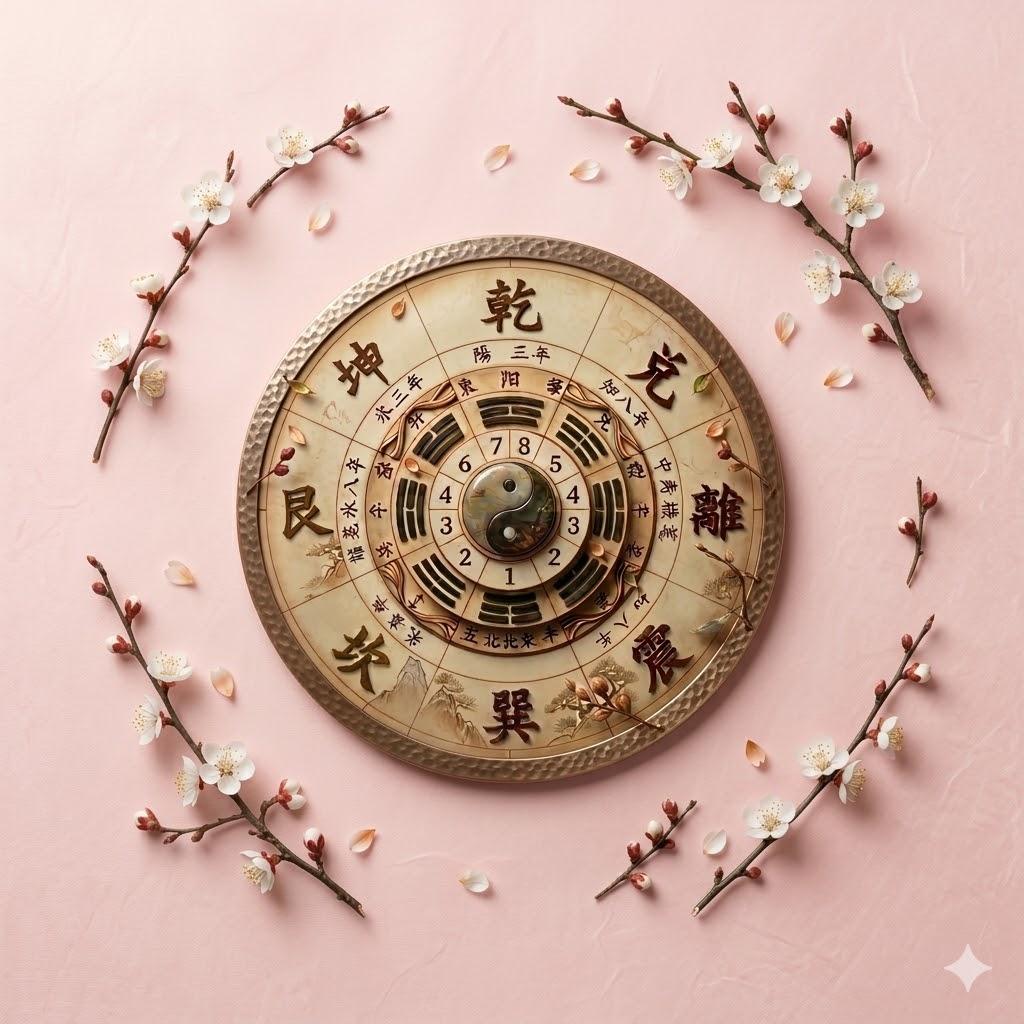
The Guan Mei Zhan ("observing the plum blossoms") is the time-casting case recorded in Book One of the Mei Hua Yi Shu. Shao Yong sees two sparrows tussle over a branch and fall to the ground, casts the numbers of the year, month, day and hour, and arrives at Revolution (Ge) with the first line moving, changing to Influence (Xian). This article quotes the original, works through every step, and re-enacts the whole cast with the on-site tool.
1. The original text
The passage below is from Book One of the Mei Hua Yi Shu (Wikisource, a public-domain classical text). The Chinese is quoted as it stands; the English is our translation.
辰年十二月十七日申時,康節先生偶觀梅,見二雀爭枝墜地。先生曰:「不動不占,不因事不占。今二雀爭枝墜地,怪也。」因占之,辰年五數,十二月十二數,十七日十七數,共三十四數,除四八三十二,餘二,屬兌,為上卦,加申時九數,總得四十三數,五八除四十,餘得三數,為離,作下卦。又上下總四十三數,以六除,六七四十二,餘一為動爻,是為澤火革。初爻變咸,互見乾巽。斷之曰:「詳此卦,明晚當有女子折花,園丁不知而逐之,女子失驚墜地,逐傷其股。右兌金為體,離火克之。互中巽木,複三起離火,則克體之卦氣盛。兌為少女,因知女子之被傷,而互中巽木,又逢乾金兌金克之,則巽木被傷,而巽為股,故有傷股之應。幸變為艮土,兌金得生,知女子但被傷,而不至凶危也。」(年月日時占例)
Translation. On the seventeenth day of the twelfth month of a Chen year, during the Shen hour, Master Kangjie happened to be watching plum blossoms when he saw two sparrows fighting over a branch fall to the ground. He said: "No casting without a stir; no casting without an occasion. Now two sparrows fighting over a branch have fallen to the ground — that is strange." So he cast. The Chen year gives 5, the twelfth month 12, the seventeenth day 17: together 34. Thirty-two is four times eight, leaving a remainder of 2, which belongs to Dui — the upper trigram. Adding the Shen hour, 9, the total is 43. Forty is five times eight, leaving a remainder of 3, which is Li — the lower trigram. Again taking the total of 43 and dividing by 6, six times seven is forty-two, leaving 1 as the moving line: this is Revolution, Lake over Fire. The first line changes to Influence; the mutual trigrams are Qian and Xun. He judged: "Reading this hexagram: tomorrow evening a girl will come to pick flowers. The gardener, not knowing, will chase her; startled, she will fall to the ground and injure her thigh. Dui Metal is the body, and Li Fire overcomes it. In the mutual trigrams, Xun Wood again feeds Li Fire, so the qi of what overcomes the body is strong. Dui is the young girl — hence a girl will be hurt. The Xun Wood in the mutual trigrams is moreover overcome by Qian Metal and Dui Metal; Xun Wood is injured, and Xun is the thigh — hence the injury to the thigh. Fortunately the change produces Gen Earth, which generates Dui Metal, so we know the girl will only be hurt and not in real danger." (A year-month-day-hour example.)
Two notes. "No casting without a stir, no casting without an occasion" is the rule for when to cast at all. The clause translated "again feeds Li Fire" reads differently in different editions; the Chinese above follows the Wikisource text.
2. Casting: where each number comes from
| Step | Numbers | Arithmetic | Result |
|---|
| Upper trigram | year + month + day | 5 + 12 + 17 = 34; ÷ 8 leaves 2 | 2 is Dui — the upper trigram |
| Lower trigram | add the hour | 34 + 9 = 43; ÷ 8 leaves 3 | 3 is Li — the lower trigram |
| Moving line | the total | 43 ÷ 6 leaves 1 | the first line moves |
The year number is the position of its earthly branch in the twelve-branch cycle (Zi 1, Chou 2 … Hai 12): Chen is fifth, hence 5. The hour number works the same way: Shen is ninth, hence 9. Which remainder maps to which trigram is fixed by the Earlier Heaven numbers — Qian 1, Dui 2, Li 3, Zhen 4, Xun 5, Kan 6, Gen 7, Kun 8. The full table is on the casting page.
So Dui above Li gives Revolution (Ge). The first line moves: the bottom line of Li flips from yang to yin, Li becomes Gen, and the hexagram changes to Influence (Xian). "The mutual trigrams are Qian and Xun" refers to the mutual hexagram, built from lines 2, 3 and 4 (Xun) and lines 3, 4 and 5 (Qian) of Ge: Heaven over Wind, Gou.
All three hexagram names (Ge, Xian, Gou) and every number above were verified with our casting engine.
3. Reading it: body, use, mutual, changed
- Body and use. The moving line is in the lower trigram. By the rule "the moving is the use, the still is the body", the upper trigram Dui Metal is the body and the lower trigram Li Fire is the use. Fire overcomes Metal — "the use overcomes the body" — which is why the text says "Dui Metal is the body, and Li Fire overcomes it."
- The mutual hexagram. It contains Xun Wood; Wood feeds Fire, adding fuel to the Li Fire that presses on the body — hence "the qi of what overcomes the body is strong".
- Images. Each trigram has standard correspondences with people and with parts of the body: Dui is the young woman, Xun is the thigh. The Xun Wood in the mutual trigrams is itself overcome by Qian Metal and Dui Metal, which is how the reading arrives at "a girl" and "an injury to the thigh".
- The changed hexagram. The lower trigram of Xian is Gen Earth; Earth generates Metal, supporting the body trigram Dui Metal — hence "only hurt, and not in real danger".
In one sentence: the body is under pressure, but the changed hexagram comes to its support — a fright without serious harm.
4. What the case teaches
It runs through the basics of Mei Hua Yi Shu in one go:
- Where the numbers come from — time casting takes the lunar year, month and day plus the hour;
- How the trigrams are fixed — the remainders are looked up in the Earlier Heaven numbers;
- How body and use are assigned — the trigram containing the moving line is the use, the other is the body;
- How the layers are read — the original hexagram for the present, the mutual for the process, the changed for the outcome;
- How images are taken — each trigram has correspondences (people, body parts, directions) that give a reading its specifics.
One thing should be said plainly: the Mei Hua Yi Shu is attributed to Shao Yong of the Northern Song but was written down later, and whether the case happened as told cannot be verified. We treat it as traditional material that explains a method. The outcome is the book's own narrative and is not evidence that the method works.
5. Re-enacting the cast with the on-site tool
The Mei Hua Yi Shu tool casts by time, by characters or by numbers. Time casting can use the current moment or a date and time you choose.
Take 16 January 2025 — the seventeenth day of the twelfth lunar month of a Chen year. Choose the custom time and enter any moment between 15:00 and 16:59 that day (the Shen hour). The upper number comes out as 34 and the lower as 43: Revolution (Ge) with the first line moving, mutual hexagram Gou, changed hexagram Influence (Xian) — exactly as in the original. Chen years recur every twelve years, and any Chen year gives the same result on that date and hour. Before 15:00 or from 17:00 the hour branch changes, and so does the hexagram.
How the site handles casting conventions and school disagreements is set out on the methodology page.
Frequently asked questions
Did the Guan Mei Zhan really happen?
It is a case recorded in the Mei Hua Yi Shu. The book is attributed to Shao Yong but written down later, and whether the case happened as told cannot be verified. We quote the original and work through the method without judging the outcome.
Which trigram is the body in the Guan Mei Zhan?
Dui. The moving line is the first line, in the lower trigram Li; by "the moving is the use, the still is the body", Li is the use and Dui is the body.
Why cast with the Earlier Heaven numbers?
That is the standard Mei Hua Yi Shu convention: Qian 1 through Kun 8, and the remainder picks the trigram. Directions and elements are a separate set of correspondences — see the table on the casting page.
Can I re-enact it with the online tool?
Yes. Choose the custom time and enter any moment between 15:00 and 16:59 on 16 January 2025; the tool casts Revolution (Ge) with the first line moving.
A case teaches a method, not proof of efficacy. What it offers is a structure for looking at a question, not a promise about the outcome.
Further reading
- Mei Hua Yi Shu online casting — cast by time, characters or numbers, with the original, mutual and changed hexagrams
- I Ching hub — the three casting methods and the 64 hexagrams
- Casting methods, probabilities and fidelity — how the site handles conventions and school disagreements